

Introduction
Located about ten kilometers east of Padua, the Laboratories occupy a large area in the outskirts of of Legnaro, on the border Ponte San Nicolò.
The Laboratories permanent staff counts on 145 members. Approximately 250 people access the laboratories every day with an annual average of 700 external users.
The accelerators provide ion beams for nuclear physics and nuclear astrophysics studies and interdisciplinary research.
The development and innovation in the field of particle accelerators, radiation detectors and on the associated technologies are the strengths of the Laboratories.
Of particular relevance are the technology transfer activities that exploit the expertises of the laboratories on surface treatment technologies, thin film deposition, and, in the future, the production of radioisotopes of medical interest.
History
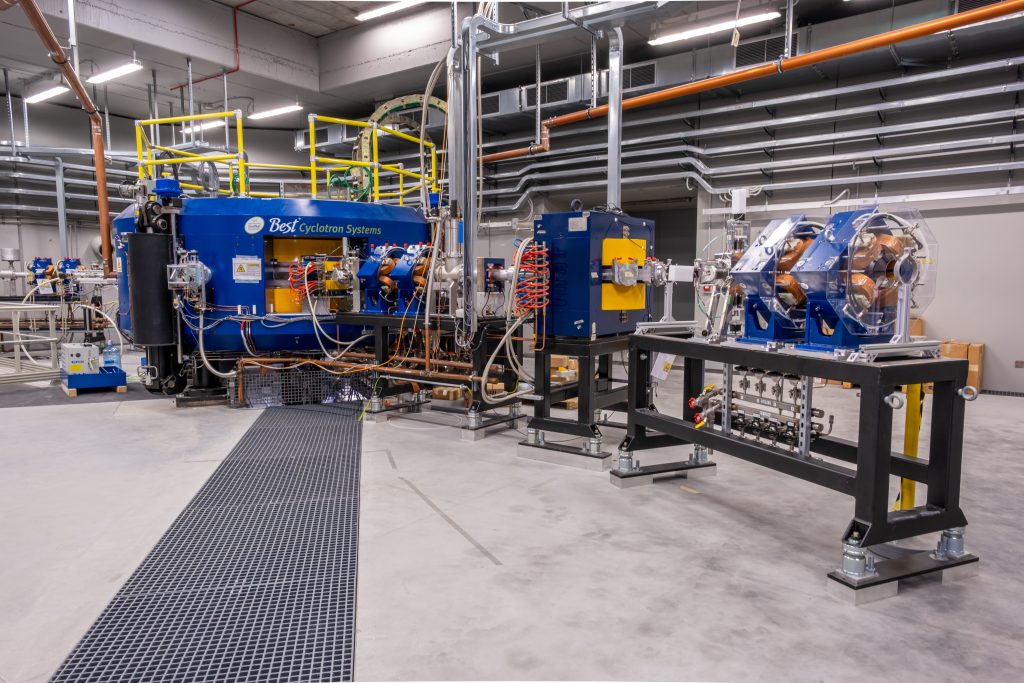
Established in 1961 as the Nuclear Research Center of the Veneto region, the facility became the second INFN National Laboratory in 1968. The quality of the stable ion beams—ranging from hydrogen to lead and produced by the various operational accelerators (the Tandem-ALPI-PIAVE [TAP] complex and the AN2000 and CN electrostatic accelerators)—combined with the instrumentation installed in the experimental halls, establishes the laboratory as a world-class research center in low-energy nuclear physics, recognized as a European Large-Scale Facility. In 2016, a proton cyclotron was installed and successfully commissioned; it serves as the core of the SPES infrastructure—currently nearing completion—which will expand the facility’s international user base. The laboratory also hosts a distributed computing center, making a significant contribution to the storage and analysis of data collected at the LHC by the CMS and ALICE experiments. Expertise in particle accelerator development has enabled major contributions to the IFMIF project—through the construction of a radio-frequency quadrupole (RFQ)-based injector installed in Rokkasho (Japan) in 2016—and to the ESS project, involving the design and construction of the Drift Tube Linac installed in Lund (Sweden) in 2019.
Now ongoing: experimental activities
Experiments currently underway at the TAP complex focus primarily on studying the structure of exotic nuclei (such as those created in stars)—produced via specific nuclear collisions—and the various mechanisms involved in nuclear reactions. Structural studies are currently conducted using the AGATA, a gamma-ray spectrometer (a system of liquid-nitrogen-cooled, high-purity germanium detectors) coupled with various complementary detectors. Investigating reaction dynamics, however, requires different instruments specialized in detecting and identifying the specific fragments produced: the PRISMA magnetic spectrometer, the GARFIELD multi-detector, the electrostatic deflector and PISOLO time-of-flight spectrometer.
Meanwhile, numerous interdisciplinary physics activities utilizing ion beams are carried out at the AN2000 and CN accelerators; these include experiments dedicated to the elemental analysis of diverse samples, target characterization for the development of innovative radioisotopes, and microdosimetry studies, and the irradiation of detectors and electronic devices.
Future
The laboratories’ primary objective is the completion and commissioning of SPES, which will enable the production of unstable ion beams for fundamental nuclear physics, as well as innovative and experimental radionuclides for medical diagnostics, therapy, and other applications. The AGATA gamma-tracking spectrometer—representing the state of the art in gamma-ray detection—is installed at LNL for an intensive measurement campaign using stable and unstable ion beams; initially, also coupled with PRISMA: AGATA will stay at LNL till 2028.