


The Radioisotope Service for Medicine and Applied Physics coordinates activities relating to the innovative production of radionuclides using proton beams from the SPES cyclotron. Two complementary methods are employed for this purpose: the direct activation method and the ISOL technique. These radionuclides can be used for medical research (such as PET and SPECT imaging and therapy), or for other applications (such as industrial and environmental uses).
In the direct activation method, a dedicated target is irradiated with proton beam. This target is specifically designed (considering target material, isotopic enrichment, purity, thickness, irradiation parameters, etc.) to produce the desired medical radionuclide. After the bombardment, a radiochemical process is required to extract and purify the medically relevant radioisotope from all the irradiated material, including the co-produced contaminants.
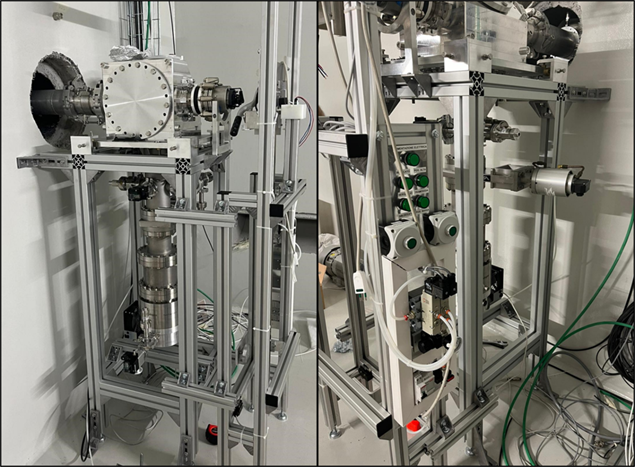
In the ISOL technique, a proton beam hits a thick uranium carbide (UCx) target. This generates a set of fission fragments, most of which are released from the target due to the high operating temperatures, which are generally higher than 2000 °C. These released nuclei are converted into positive ions and extracted as a particle beam. Thanks to the presence of a mass separator, it is possible to select nuclei with the same mass as the desired isotope. These nuclei can then be collected on suitable deposition substrates.
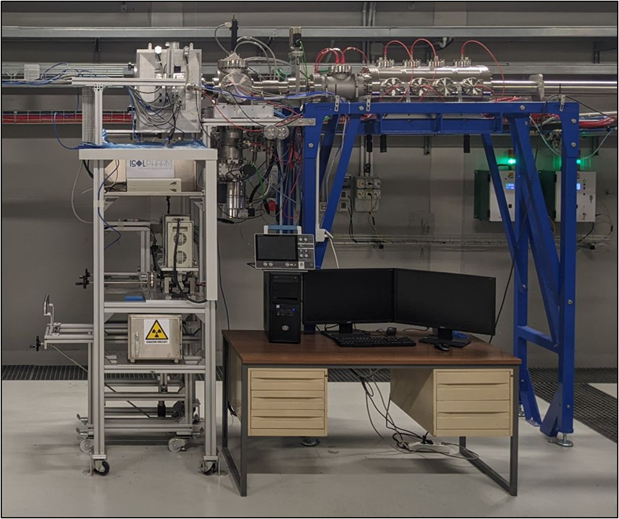
The isotopes produced using these two different nuclear techniques, following radiochemical purification, can then be used for the labelling of different radiopharmaceuticals.